Note - this twitter thread] is where I first heard the terms bottom-up vs top-down learning
- By bottom-up learning I mean learning by collecting all the more basic, essential facts, memorising them, then going up to the next level of abstraction/complexity, memorising/grokking this level, then climbing up, etc
- Michael Nielsen details it in his incredible Augmenting Long-Term Memory post from his Augmenting Cognition blog:
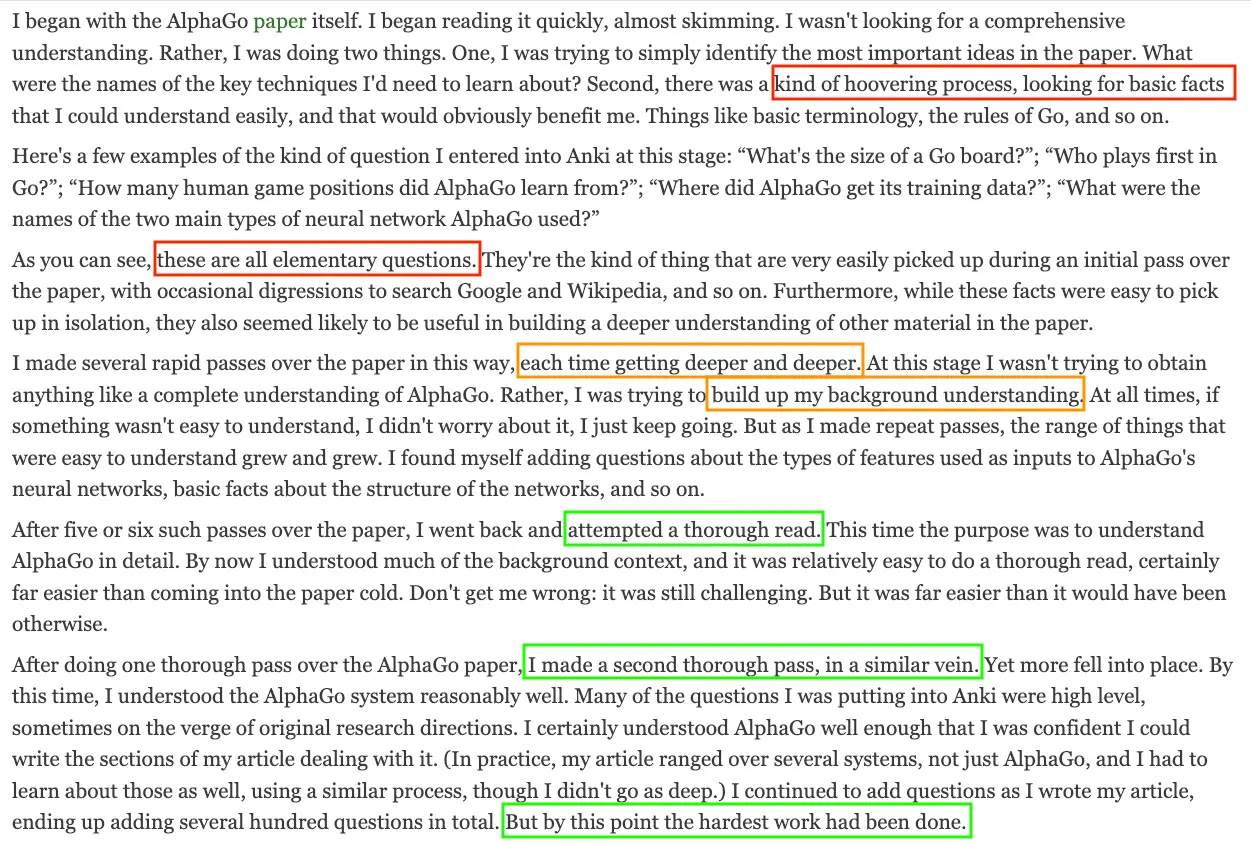
- So yeah, it’s the case of thoroughly getting to grips with everything, in order. Front-loading the learning, not trying to grapple complex stuff straight away
- It’s super super powerful. For one job I was applying for recently, whilst waiting to do my 2-day in person work trial, I decided to spend 3 days learning about the “nuclear security” Effective Altruism cause area. At first you drown in acronyms and treaties and don’t know what the hell is going on, then you systematically learn them all and the context around them and boom, you have a solid base level of understanding and can talk to people about the stuff. It’s really really cool
- See also Hermeneutic circle, hermeneutic spiral
The failure mode
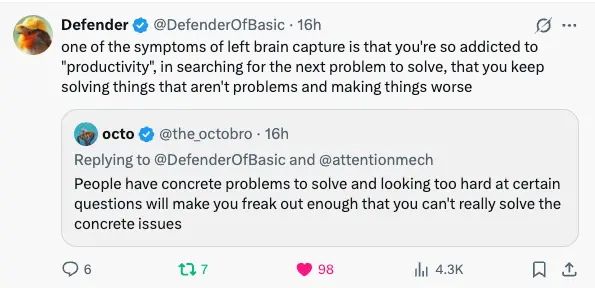
- The failure mode of this is that it can be a little infantilising → there’s a sense of “well, I can’t grapple with anything beyond my understanding yet, I need to learn all the basic facts first”
- For me this manifested as e.g. “I won’t think about current affairs, to get a better world model I’ll first have to learn the basics of various fields, like maybe if I read and make thorough flashcards from an economics textbook then one day I’ll be ready to grapple with ‘real’ things”
Why it’s needed
- From What do I know about business, on day 0 of my learning sprint? (2026-05-16):
- (The reason you also need bottom-up IMO is because of the “Concept-Shaped Holes Can Be Impossible To Notice” thing (Slate Star Codex post) - you also need to go to the well rather than trying to invent everything from scratch)
- An example here is like, I just now searched for a tutorial on how to rotoscope in DaVinci Resolve. Of course, if I didn’t know the term “rotoscope”, I wouldn’t know to search this. I might ask Claude about it without knowing the terminology (“hey, how do I extract myself from a video, removing the background? Is there a name for this?“)
- Turns out this is similar to reading to understand (as opposed to reading to engage)